Support Ops & Teams
Published on
21.11.2025
Last updated on
01.09.2026
How to Write a Bad Review Response That Actually Helps
.avif)
Andrew
Chief Commercial Officer

Andrew
Chief Commercial Officer
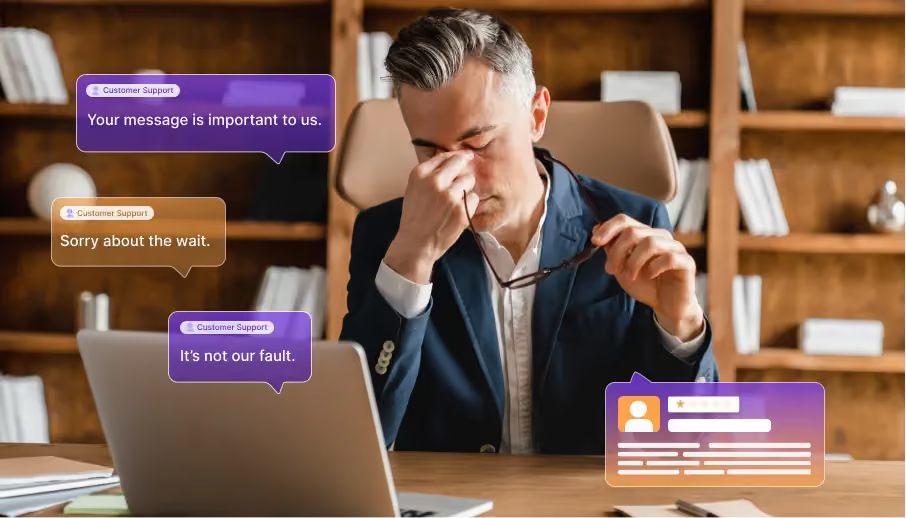
When a negative review lands on Google, Yelp, or Trustpilot, most businesses either ignore it or write a generic apology that doesn’t land. The instinct is to protect the brand from public embarrassment — but the companies that handle negative feedback best treat it as a product, service, and operational signal. This guide breaks down how to respond to negative reviews in ways that actually improve customer retention and public perception.
Every negative review is a customer who cared enough to tell you what went wrong. Most unsatisfied customers don’t leave reviews — they leave. So when someone takes the time to document their frustration publicly, they’re giving you information and an opportunity. How you respond to that moment defines how future customers, potential employees, and business partners perceive your organization.
High-performing customer service teams treat negative review responses as a discipline with specific mechanics, not as a PR exercise. Let’s break those mechanics down. For a deeper look at both review response strategy and examples you can model, see our detailed guide: How to Respond to Negative Reviews with Real-Life Examples.
76% of consumers demand the flexibility to switch between calling and messaging according to their preferences. Even a basic AI-based chatbot is superior to none. A prominent business sets an example:

What’s wrong with this example:
Solution: Design a user-friendly 'Contact Support' option that includes a quick chat feature. If chatbots aren't an option, guarantee a two-hour response time from your agents. Also, include a convenient button that auto-opens an email form, minimizing customer effort.
Trying to deceive your clients is the first warning sign that churn is coming.
Nearly all consumers – 97% – want transparency about who they're talking to: a human or AI. What's more, 73% are more likely to make a purchase from a company that openly uses human-monitored AI.
Solution: So, be upfront. Clearly label AI responses or include a message like "I'm Name, your virtual assistant." Also, consider offering a quick way for customers to connect with a human agent if they need more help. Honesty and flexibility are key.
This one is more obvious. Yet, an assured way to increase churn rate. For instance, a customer requests account recovery. It’s a disaster when a simple account recovery query gets automated ‘Thank you for contacting us’ without any details about timing.
Example:

Solution: Design engaging, authentic auto-responses with a specific reply deadline. Replace vague phrases like "We'll contact you as soon as possible" with a clear commitment. Consider switching your email domain from noreply@yourcompany to pleasereply@yourcompany. Here, the best approach is to break away from clichés.
Having background noise during customer calls is the best way to show “Hey, we don’t care about you.” I’ve seen a case on Reddit with a person complaining about a rooster crowing SO loudly on the line that they thought a customer supported us in one room with a rooster.
Solution: Ensure every support agent in a team follows strict communication policies and works within proper conditions. It also depends on the type of headphones customers use. It ensures customers feel like their call is indeed appreciated and they are actively listened to.
Let’s start immediately with the example and analyze it:

What’s wrong:
Solution: gather questions and complaints from customer service to identify common issues.use website analytics to see how customers browse your site and identify pages where they drop off. Look for patterns in customer email inquiries to find common questions. And regularly repeat. Customer needs and your website will change over time so keep looking for feedback.
Conversation based just on scripts is another dead end. Most customer service lines have a script to run through, and most customer service agents don’t care enough to do anything beyond reading through.
Here’s a prominent example:

What's wrong with this case:
Solution: there is nothing wrong in trying to persuade a customer to stay for the first time. However, if one offer didn't work, others are destined to fail. If a customer expresses one's position clear, a customer support agent should do everything possible to make it as easy as possible for customer to quit.
This one is indeed infuriating. We’ve all experienced it several times.
You must start from scratch every time you are transferred to other agents. All call centers use scripts and nothing pisses customers off more than having the same questions 6 times.
Solution: make sure that the call is being transferred correctly to the right agent before taking it. It’s also worthwhile to write down as many notes as possible about what the issue is. The most important rule here is to ensure the next agent doesn’t ask the same questions as the standard script.
Transform your customer experience by avoiding these costly mistakes that lead to customer churn. Clear communication, convenient contact options, and empowered team members can turn frustrated customers into loyal fans, reducing churn and boosting satisfaction. Investing in customer service pays off.
If building a top-notch team in-house is not feasible, consider outsourcing to experts who can provide 24/7 exceptional service, allowing you to focus on your core business.
Sign up for a free call with your customer support audit today and see how EverHelp can transform your customer experience!
Help someone else stay in the know. Hit that share button!

.png)

%2520(1).avif)